|
English Church Architecture.
KILPECK, St. Mary & St. David (SO 445 305), HEREFORDSHIRE. (Bedrock: Silurian Pridoli Series, Raglan Mudstone Formation.)
One of the foremost Norman churches in England.
Except, perhaps, for the insertion of a verb, it is impossible to begin an account of this church more appropriately than Pevsner, when he wrote in the Herefordshire volume in The Buildings of England (Harmondsworth, Penguin, 1963, p. 201), 'One of the most perfect Norman village churches in England, small but extremely generously decorated, and also uncommonly well preserved'. Indeed, those last three words apply as much in today as when Pevsner visited, for the carving on the outside of the building is still crisp today after exposure to almost nine centuries of English weather.
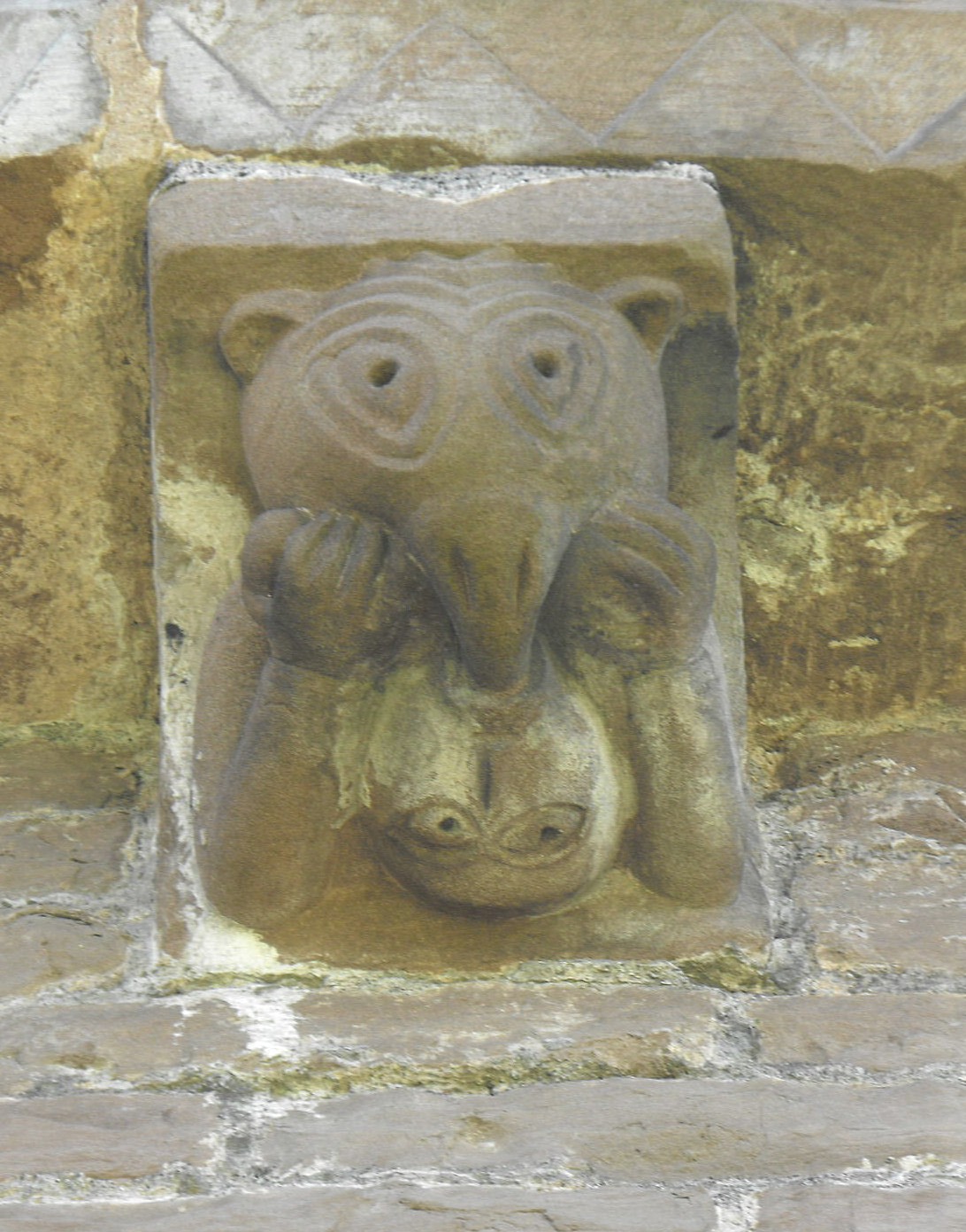
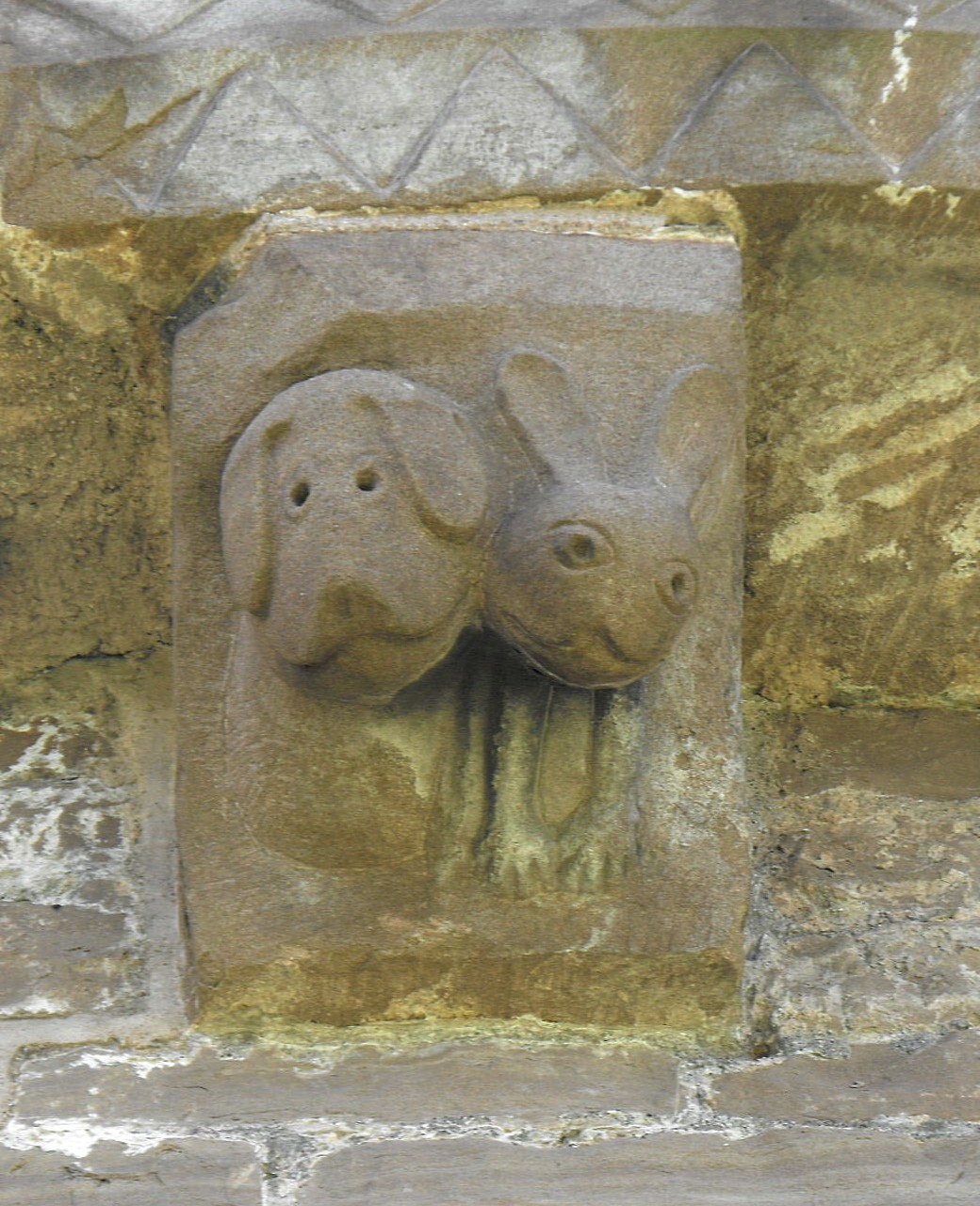
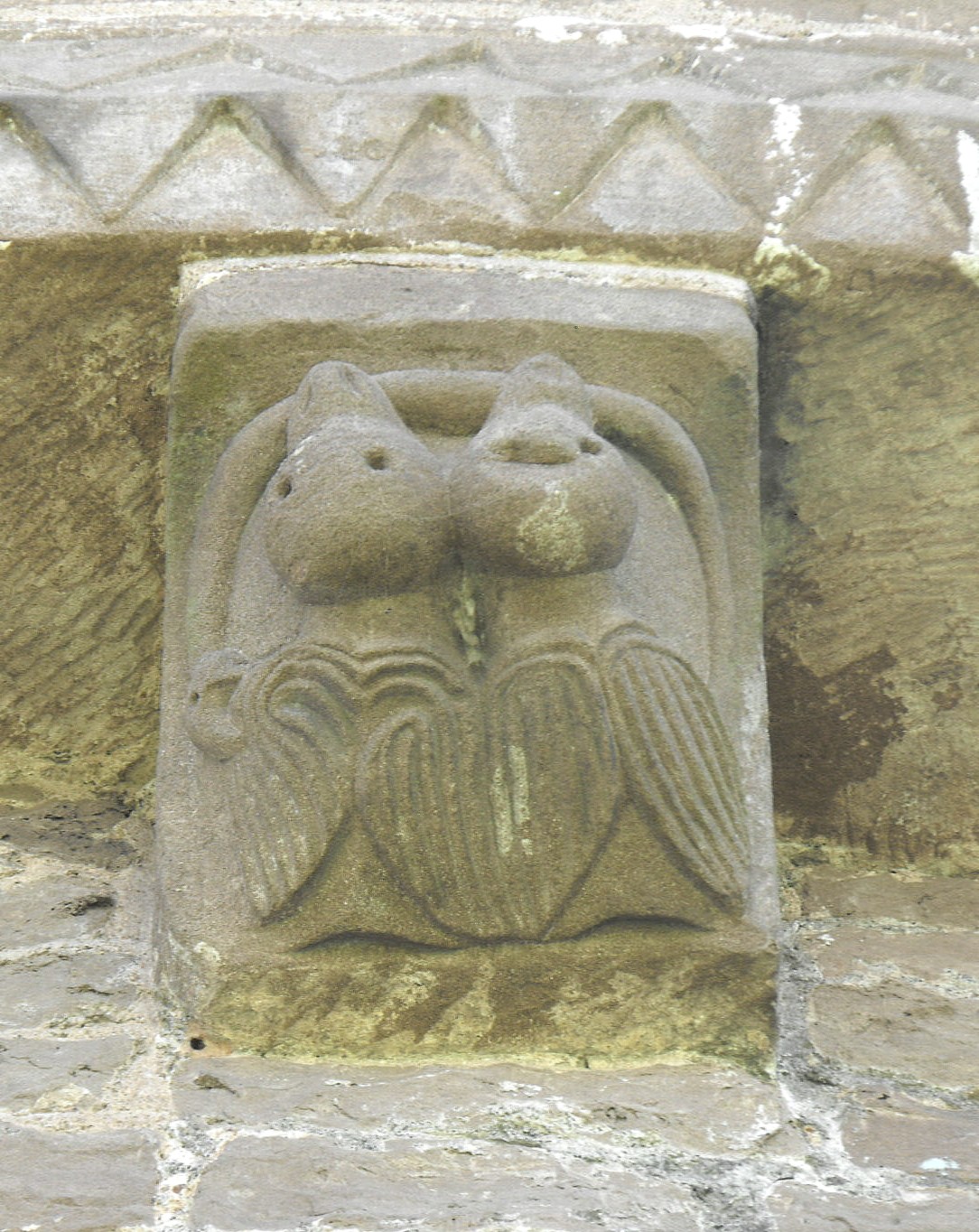
The corbel table is the work of other hands and it seems likely that at least two men were responsible for it. There are eighty-nine corbels altogether, all of which are described and illustrated by Thurlby, but half a dozen from the apse will give the flavour here. Numbered from the southwest angle of the nave and proceeding anticlockwise, the photographs show: no. 33 (above left), a rather comical portrayal of a hound and a hare; no. 35 (above right), a beaked animal pecking at an inverted human head; no. 36 (below left), two birds biting a snake; no. 39 (below right), which is aligned due east, an Agnus Dei, although the animal resembles a horse much more than a lamb; no. 45 (at the foot of the page on the left), two disreputable-looking figures dancing; and no. 47 (at the foot of the page on the right), a bald female figure described by Thurlby as 'turned away as if in horror or disgust' (The Herefordshire School of Romanesque Sculpture, pp.119-121). Thurlby suggests the possible meaning of some of these corbels with reference to the Bestiary, but most of his interpretations appear distinctly tenuous.
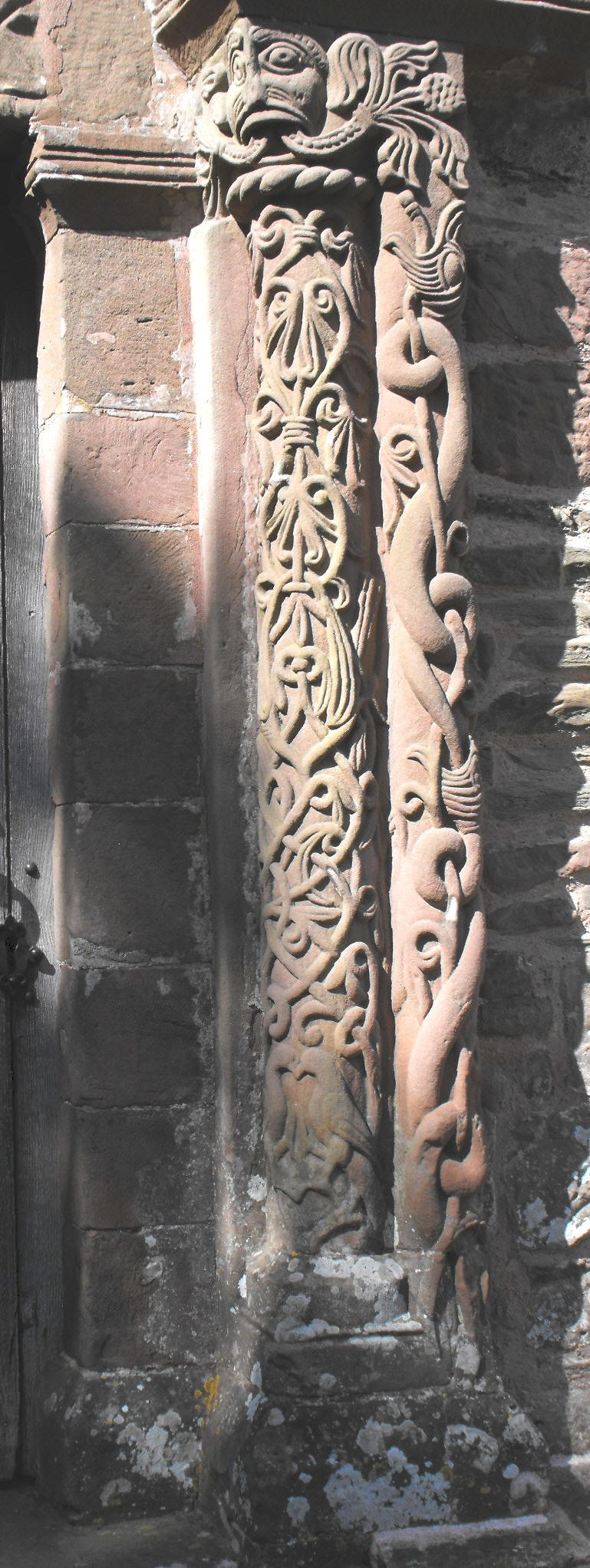
Kilpeck church today is lit by six surviving Norman windows and a pair of cusped lancets, inserted opposite each other in the chancel, probably around 1300. The original windows consist of three around the apse, now externally renewed, and one each in the north, south and west walls of the nave, of which the last is by far the most elaborate, with side-shafts and a roll around the arch, tightly covered in beaded and two-strand interlace respectively, and capitals described by Thurlby as taking 'the form of huge masks with foliage issuing from the mouths'. (See the photograph below.)
Inside the building, it is the view to the east that impresses, created by the ornately decorated chancel arch, the slightly smaller unmoulded arch to the apse beyond, and the rib-vaulted apse itself, with ribs due north, northeast, southeast and due south, all richly provided with lozenged chevron, like the window splays between, where the mouldings rest on nook-shafts with scalloped capitals. The chancel arch is composed of three orders above jambs of just two, the former bearing a roll and a band of saltire decoration on the inner order, horizontal chevron on the middle order, and chevron on the extrados of the arch on the outer order. The inner order of the jambs is unmoulded but the outer has 'shafts' formed of three superimposed figures on each side, probably intended to represent saints since the middle figure to the left (north) appears to be St. Peter (illustrated below left) judging from the key carried on his right shoulder. (The photograph, below right, shows the central figure to the right [south].) The capitals above are scalloped on the right hand side and decorated with leaf carving on the left.
These are the salient features for later work amounts to very little. The simple wooden gallery with turned balusters, supported on two wooden columns, is Jacobean or Carolean, and interesting for that reason. Pevsner dated the little bellcote above the west gable to the church's restoration in 1864 (The Buildings of England: Herefordshire, p. 203), which Thurlby ascribes to John Pollard Seddon (1827 - 1906) (The Herefordshire School of Romanesque Sculpture, p. 95), who carried out most of his work in Wales and the west.
|

 Kilpeck church is
formed of a nave,
chancel and stilted apse of successively diminishing heights and
widths, in a plan that may also be found at nearby Moccas, leading
Malcolm Thurlby, who considers the team of men responsible for the
sculpture at Kilpeck to have been different from the team
responsible for the basic architecture, to suggest the latter was
the same at both places (The Herefordshire School
of Romanesque Sculpture, Almeley, Logaston Press, 2013, p. 78).
Constructed of what is clearly an unusually hard-wearing Old Red
(Devonian) Sandstone, whose outcrop begins only a few hundred yards to
the southeast, the masonry is uncoursed in the nave and chancel but
squared and coursed around the apse, giving the apse a suitably increased
emphasis, albeit the whole church is supported by similar pilaster
buttresses at roughly equal intervals and surrounded beneath the
eaves by a continuous corbel table formed of carved animals and
heads. The building's most striking external feature is the
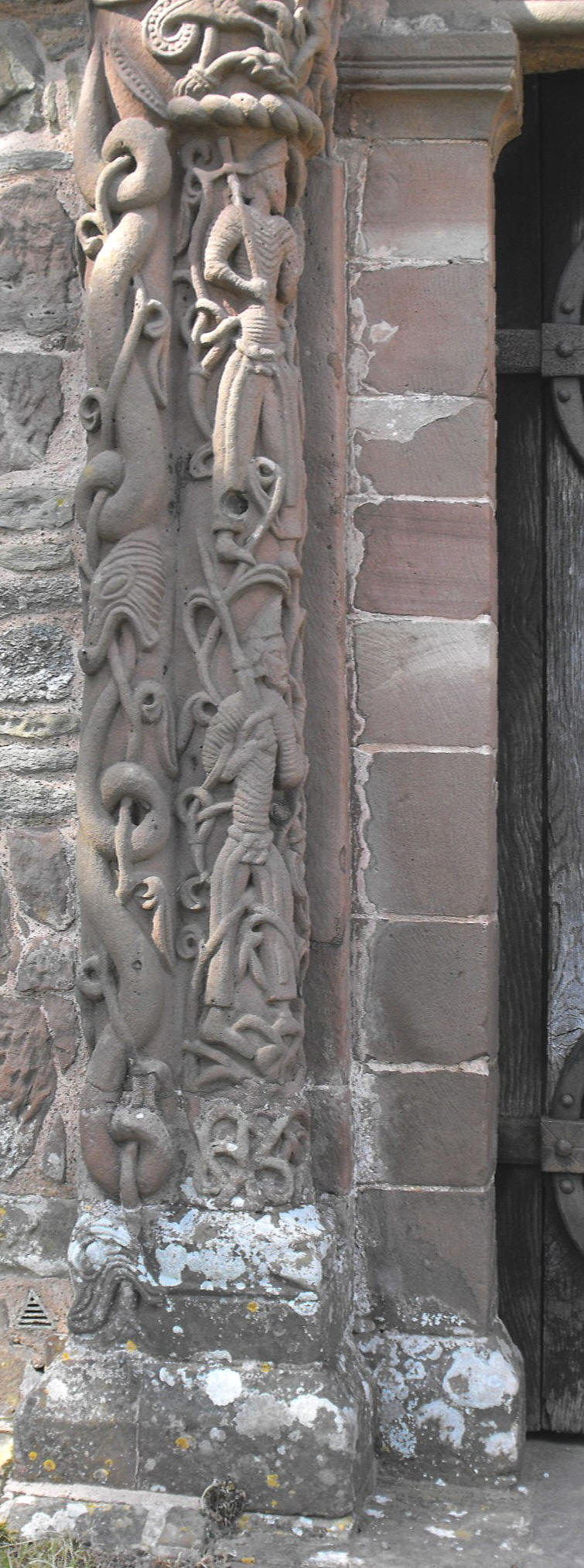
exceptional S. doorway, which Thurlby describes in detail. (See also the photographs, showing:
above centre, a complete view of the doorway; above left and
above right, close-ups of the shafts; and right, a close-up of
the lower right-hand portion of the arch immediately above the
springing.)
He begins by pointing out that the mouldings at the top of the plain inner
order are not continuous with the abaci above the capitals of
the outer order - an unusual arrangement that seems to distinguish
the products of this workshop. The inner shaft on the left is
carved to
depict two knights, one above the other, who, perhaps, guard the
doorway to prevent the two serpents in Viking Ringerike style on the
outer shaft from entering, and this theme of the struggle between
good and evil is taken up on the voussoirs forming the arch, which
display animals from the Bestiary arranged as beakhead on the inner
order and set in linked medallions around the outer order, together with an angel at the apex of the
inner order, who carries a sword and watches over all.
Kilpeck church is
formed of a nave,
chancel and stilted apse of successively diminishing heights and
widths, in a plan that may also be found at nearby Moccas, leading
Malcolm Thurlby, who considers the team of men responsible for the
sculpture at Kilpeck to have been different from the team
responsible for the basic architecture, to suggest the latter was
the same at both places (The Herefordshire School
of Romanesque Sculpture, Almeley, Logaston Press, 2013, p. 78).
Constructed of what is clearly an unusually hard-wearing Old Red
(Devonian) Sandstone, whose outcrop begins only a few hundred yards to
the southeast, the masonry is uncoursed in the nave and chancel but
squared and coursed around the apse, giving the apse a suitably increased
emphasis, albeit the whole church is supported by similar pilaster
buttresses at roughly equal intervals and surrounded beneath the
eaves by a continuous corbel table formed of carved animals and
heads. The building's most striking external feature is the
exceptional S. doorway, which Thurlby describes in detail. (See also the photographs, showing:
above centre, a complete view of the doorway; above left and
above right, close-ups of the shafts; and right, a close-up of
the lower right-hand portion of the arch immediately above the
springing.)
He begins by pointing out that the mouldings at the top of the plain inner
order are not continuous with the abaci above the capitals of
the outer order - an unusual arrangement that seems to distinguish
the products of this workshop. The inner shaft on the left is
carved to
depict two knights, one above the other, who, perhaps, guard the
doorway to prevent the two serpents in Viking Ringerike style on the
outer shaft from entering, and this theme of the struggle between
good and evil is taken up on the voussoirs forming the arch, which
display animals from the Bestiary arranged as beakhead on the inner
order and set in linked medallions around the outer order, together with an angel at the apex of the
inner order, who carries a sword and watches over all.