GILLING WEST,
St. Agatha (NZ 182 052) (January 2013)
(Bedrock:
Carboniferous Dinantian Subsystem, Alston Formation)

St. Agatha is an obscure Sicilian saint,
martyred by the Romans c. 251 A.D. (Wikipedia). The church dedicated to her
in this modest north Pennine village is a surprisingly large building
formed of a chancel, aisled nave and W. tower, with the addition of a N.
vestry, S. porch and - the reason it seems especially capacious - second,
lean-to outer aisle to the north, which was added in 1845 when the inner
aisle was rebuilt and independently-gabled (church guide).
(See the photograph above, taken
from the southwest.)
Indeed, on closer inspection, a large proportion of the exterior of the
church appears to be of
this date, including the entire chancel in pseudo-Norman style, the
semi-octagonal stair turret to the tower, and the
majority of the windows in all parts of the building. However, the
surviving mediaeval work is not insignificant and includes the tower, porch
and vestry.
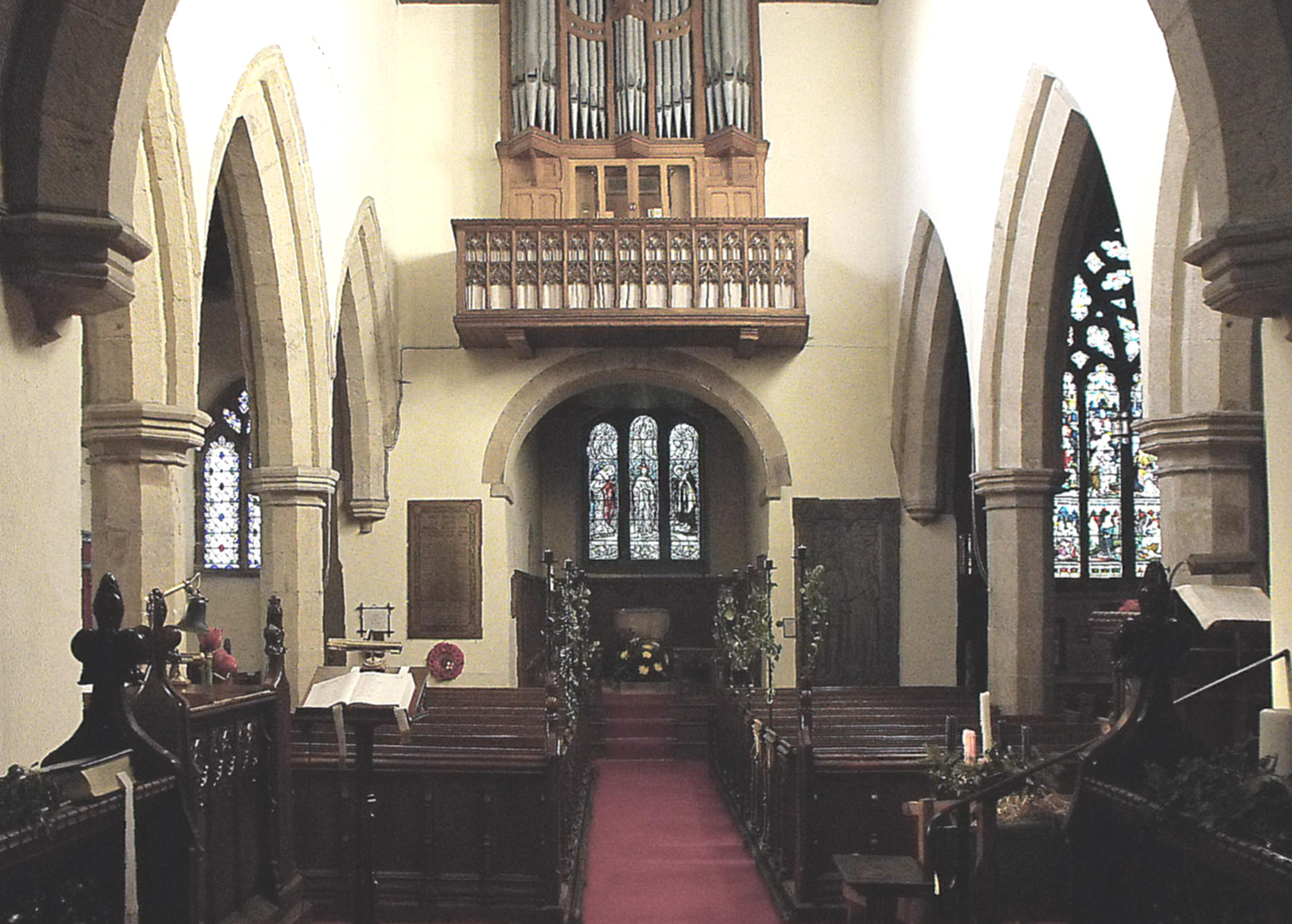 The
tower is unbuttressed and composed of three stages. It is probably the
oldest part of the building, at least in its basic fabric, although whether any of its surviving features
can truly be said to be original is possibly rather doubtful. The round-headed arch to the nave
(seen left, in the interior
view of the church taken from the east)
is described as Norman in the church guide
(Kenneth Leyburn, revised edition 1996), and the uncharacteristically thin
wall is explained away as the result of the arch being cut through still older Saxon
masonry. That is one possible explanation but another might be that
what we now see is a Tudor replacement, constructed when the present
three-light, untraceried and uncusped, W. window was inserted, and the
bell-stage and nave clerestory added, in the late fifteenth or
sixteenth centuries. That does not necessarily preclude a Saxon age for
the masonry, of course, and the church guide describes how, when repairs to
the original, blocked bell-openings (now visible only internally below the
present bell-openings) were carried out in 1995/6, it appeared likely they once
consisted of pairs of small round-headed lights, divided by baluster
mullions. Be that as it may, however, what is at least certain is that
the tower predates the nave aisles, which partially embrace it. The
tower has been restored in recent years and an appalling plaque on the west
face of the turret, reads,
"Whilst restoring this tower, which stands here to the glory of God, Dean
Emerson fell to his death on 5th September 1995, aged 31".
The
tower is unbuttressed and composed of three stages. It is probably the
oldest part of the building, at least in its basic fabric, although whether any of its surviving features
can truly be said to be original is possibly rather doubtful. The round-headed arch to the nave
(seen left, in the interior
view of the church taken from the east)
is described as Norman in the church guide
(Kenneth Leyburn, revised edition 1996), and the uncharacteristically thin
wall is explained away as the result of the arch being cut through still older Saxon
masonry. That is one possible explanation but another might be that
what we now see is a Tudor replacement, constructed when the present
three-light, untraceried and uncusped, W. window was inserted, and the
bell-stage and nave clerestory added, in the late fifteenth or
sixteenth centuries. That does not necessarily preclude a Saxon age for
the masonry, of course, and the church guide describes how, when repairs to
the original, blocked bell-openings (now visible only internally below the
present bell-openings) were carried out in 1995/6, it appeared likely they once
consisted of pairs of small round-headed lights, divided by baluster
mullions. Be that as it may, however, what is at least certain is that
the tower predates the nave aisles, which partially embrace it. The
tower has been restored in recent years and an appalling plaque on the west
face of the turret, reads,
"Whilst restoring this tower, which stands here to the glory of God, Dean
Emerson fell to his death on 5th September 1995, aged 31".
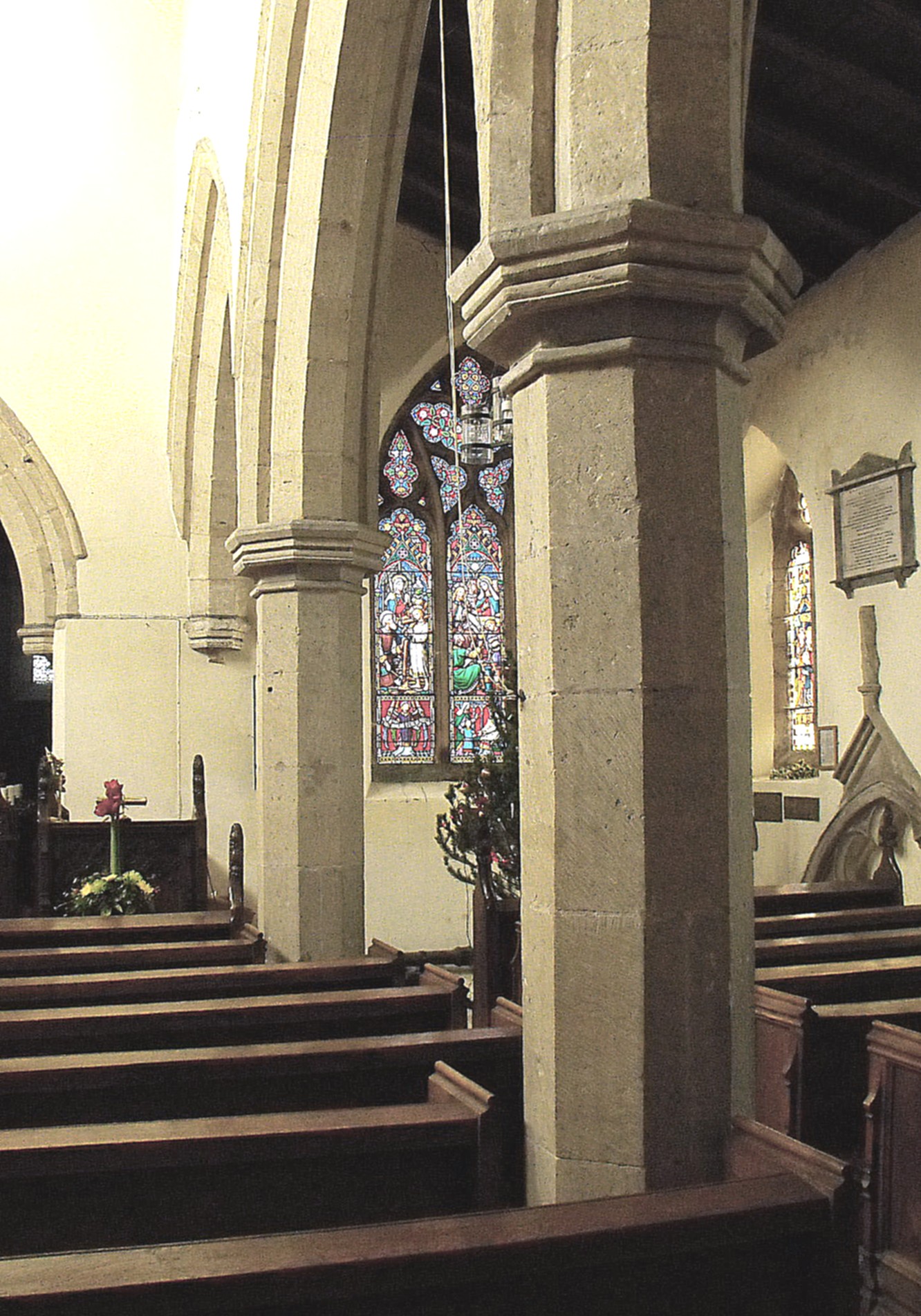 The
early fourteenth century (Decorated) three-bay nave arcades are formed of double-flat-chamfered arches supported on octagonal piers with
prominent capitals and corbels at the ends
(see
the S. arcade, right, viewed from the northwest.), but slight differences in the
capitals, north to south, demonstrate that either the two sides are not
quite contemporary or that different masons were responsible for each. The chancel arch
is also broadly of this time, while the Victorian outer aisle, although constructed
in four bays, largely copies the style of its mediaeval counterparts,
leaving just the form of its bases and its very neat mortar joints to give
its true vintage away. The N. aisle windows, in Second Pointed style, have
integral shafts decorating the splays, and the same feature to the east and
west windows of the inner N. aisle, which have curvilinear tracery, shows
that these too are part of the same phase of reconstruction. In fact, only the
internal stonework of the two-light S. aisle S. windows, with falchion
tracery, holds out hope that any of the church windows retain their
mediaeval form.
The very four-square S. porch is windowless and entered through a
disproportionately small outer doorway with a flat-chamfered surround. It is probably
contemporary with the aisle but there is little to date here with confidence: the roof is of couple construction and the inner doorway
is double-flat-chamfered. The lean-to N. vestry, which runs the
full length of the chancel and has no external features of note, was not
examined on this visit but is described in the church guide as
having "an unusual diagonally-ribbed half-tunnel vault".
The doorway leading into it from the chancel is surrounded by two sunk
quadrant mouldings, most particularly associated with the late fourteenth
century.
The
early fourteenth century (Decorated) three-bay nave arcades are formed of double-flat-chamfered arches supported on octagonal piers with
prominent capitals and corbels at the ends
(see
the S. arcade, right, viewed from the northwest.), but slight differences in the
capitals, north to south, demonstrate that either the two sides are not
quite contemporary or that different masons were responsible for each. The chancel arch
is also broadly of this time, while the Victorian outer aisle, although constructed
in four bays, largely copies the style of its mediaeval counterparts,
leaving just the form of its bases and its very neat mortar joints to give
its true vintage away. The N. aisle windows, in Second Pointed style, have
integral shafts decorating the splays, and the same feature to the east and
west windows of the inner N. aisle, which have curvilinear tracery, shows
that these too are part of the same phase of reconstruction. In fact, only the
internal stonework of the two-light S. aisle S. windows, with falchion
tracery, holds out hope that any of the church windows retain their
mediaeval form.
The very four-square S. porch is windowless and entered through a
disproportionately small outer doorway with a flat-chamfered surround. It is probably
contemporary with the aisle but there is little to date here with confidence: the roof is of couple construction and the inner doorway
is double-flat-chamfered. The lean-to N. vestry, which runs the
full length of the chancel and has no external features of note, was not
examined on this visit but is described in the church guide as
having "an unusual diagonally-ribbed half-tunnel vault".
The doorway leading into it from the chancel is surrounded by two sunk
quadrant mouldings, most particularly associated with the late fourteenth
century.
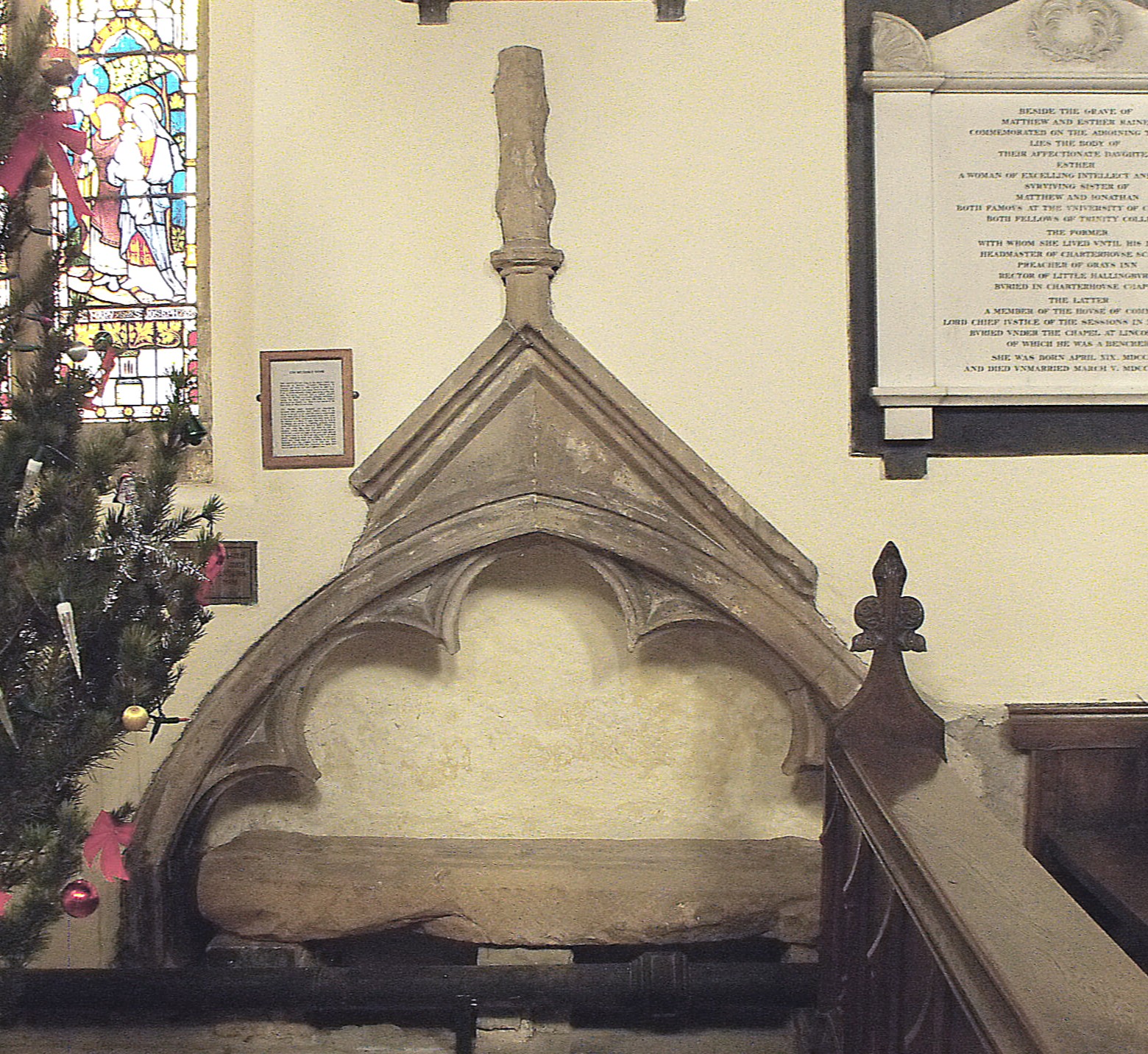 Other
features in the church include the large ogee-pointed, early fourteenth
century recess in
the S. aisle S. wall
(illustrated left), which
is now little more than a fragment. Wall monuments on this same wall
include one to the west of the porch, dedicated to James Darcy (d. 1733)
and signed by W. Green of Rotherham (fl. 1731-37), of whom Rupert Gunnis
wrote: "[His] designs are based on London work of the period, with
cartouche inscription tablets, architectural details, mourning cherubs,
etc., but the carving is first-rate, far above the level of the ordinary
provincial statuary..." (Dictionary of British Sculptors:
1660-1851, pub. The Abbey Library, 1951). This example features heraldic
beasts holding a shield against a black marble background. An earlier
monument on the nave W. wall,
to the north of the tower arch, is composed of a re-set black marble slab, showing full-length figures of Sir Henry Boynton (d
1531) and his wife, Isabella, in low relief, with an inscription in Latin
running around the perimeter.
Other
features in the church include the large ogee-pointed, early fourteenth
century recess in
the S. aisle S. wall
(illustrated left), which
is now little more than a fragment. Wall monuments on this same wall
include one to the west of the porch, dedicated to James Darcy (d. 1733)
and signed by W. Green of Rotherham (fl. 1731-37), of whom Rupert Gunnis
wrote: "[His] designs are based on London work of the period, with
cartouche inscription tablets, architectural details, mourning cherubs,
etc., but the carving is first-rate, far above the level of the ordinary
provincial statuary..." (Dictionary of British Sculptors:
1660-1851, pub. The Abbey Library, 1951). This example features heraldic
beasts holding a shield against a black marble background. An earlier
monument on the nave W. wall,
to the north of the tower arch, is composed of a re-set black marble slab, showing full-length figures of Sir Henry Boynton (d
1531) and his wife, Isabella, in low relief, with an inscription in Latin
running around the perimeter.
Finally, the font, formed of a round bowl
supported on five shafts with capitals described as "waterleaf" on
the britishlistedbuildings web-site and as "stiff-leaf" by Pevsner,
who ascribed it to "Early English" times, failed to convince the
present writer that it is actually mediaeval at all.