|
English Church Architecture.
EARLS BARTON, All Saints (SP 852 638), NORTHAMPTONSHIRE. (Bedrock: Middle Jurassic, Northampton Sand Formation.)
The church with the finest Saxon tower in England.
The importance of the tower is such that each face will now be described separately. %20-%20earls%20barton%202.jpg) S.
face (illustrated right):
The lower stage is divided into six sections and there are shallow
segmental-arched
windows at the top of the two middle divisions, with stone balusters
decorated with ring mouldings at the sides and between, and carved crosses at the apices;
a carved roundel containing a cross is placed, seemingly at random, high up
in the second division, level with the window sills. The second stage
is also divided into six and has a row of round-headed arches above the
string course, except in the second division, where there is a doorway.
The third stage is divided into seven and has two tiers of triangular-headed arches
above the string course in divisions 1-2 and 5-7 and a little
triangular-pointed window between the other two. The fourth stage
contains the bell-openings, composed of five lights separated by balusters.
W. face:
The lower stage is divided into six and has a doorway filling the central
two, with abaci formed of large rectangular blocks and two bands running
around the arch; the round-arched window above has been renewed and there
are slight remains of a pair of windows above that - once, perhaps, like
those to the south. The second stage is similar to its counterpart to
the south but what appears to be the remains of a doorway is placed in the
fourth division from the left. The third and fourth stages are also similar
to those to the south except there are only six divisions to stage three,
all showing a similarly insouciant approach to measurement.
N. face:
All stages are divided very irregularly into five. The lower two are blank.
The upper two are similar to the S and W. faces.
E. face:
Only the two upper stages are seen above the nave roof. There is a
window high up in the third division of the third stage, and another, low down,
breaking through the lower string course.
S.
face (illustrated right):
The lower stage is divided into six sections and there are shallow
segmental-arched
windows at the top of the two middle divisions, with stone balusters
decorated with ring mouldings at the sides and between, and carved crosses at the apices;
a carved roundel containing a cross is placed, seemingly at random, high up
in the second division, level with the window sills. The second stage
is also divided into six and has a row of round-headed arches above the
string course, except in the second division, where there is a doorway.
The third stage is divided into seven and has two tiers of triangular-headed arches
above the string course in divisions 1-2 and 5-7 and a little
triangular-pointed window between the other two. The fourth stage
contains the bell-openings, composed of five lights separated by balusters.
W. face:
The lower stage is divided into six and has a doorway filling the central
two, with abaci formed of large rectangular blocks and two bands running
around the arch; the round-arched window above has been renewed and there
are slight remains of a pair of windows above that - once, perhaps, like
those to the south. The second stage is similar to its counterpart to
the south but what appears to be the remains of a doorway is placed in the
fourth division from the left. The third and fourth stages are also similar
to those to the south except there are only six divisions to stage three,
all showing a similarly insouciant approach to measurement.
N. face:
All stages are divided very irregularly into five. The lower two are blank.
The upper two are similar to the S and W. faces.
E. face:
Only the two upper stages are seen above the nave roof. There is a
window high up in the third division of the third stage, and another, low down,
breaking through the lower string course.
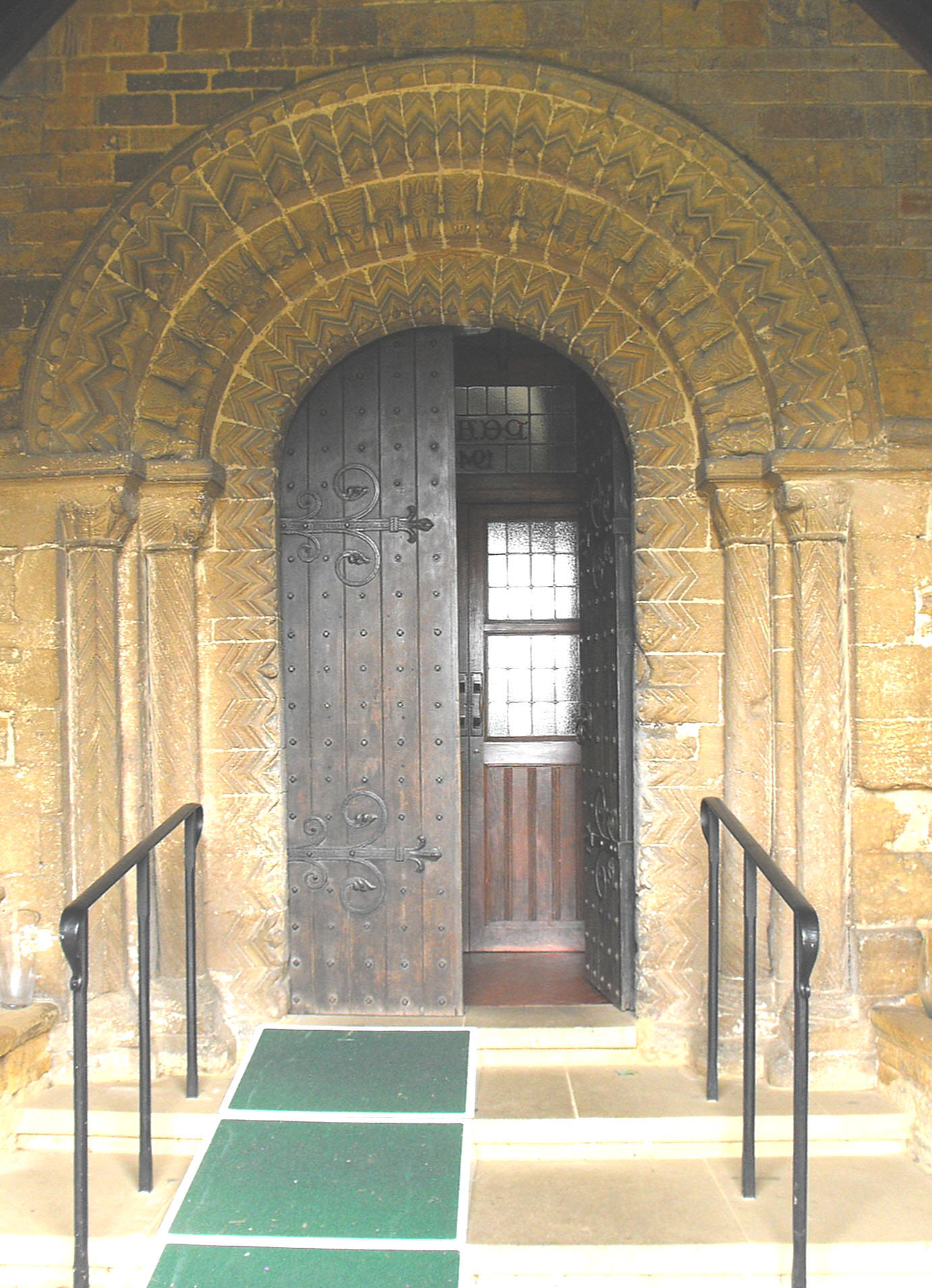 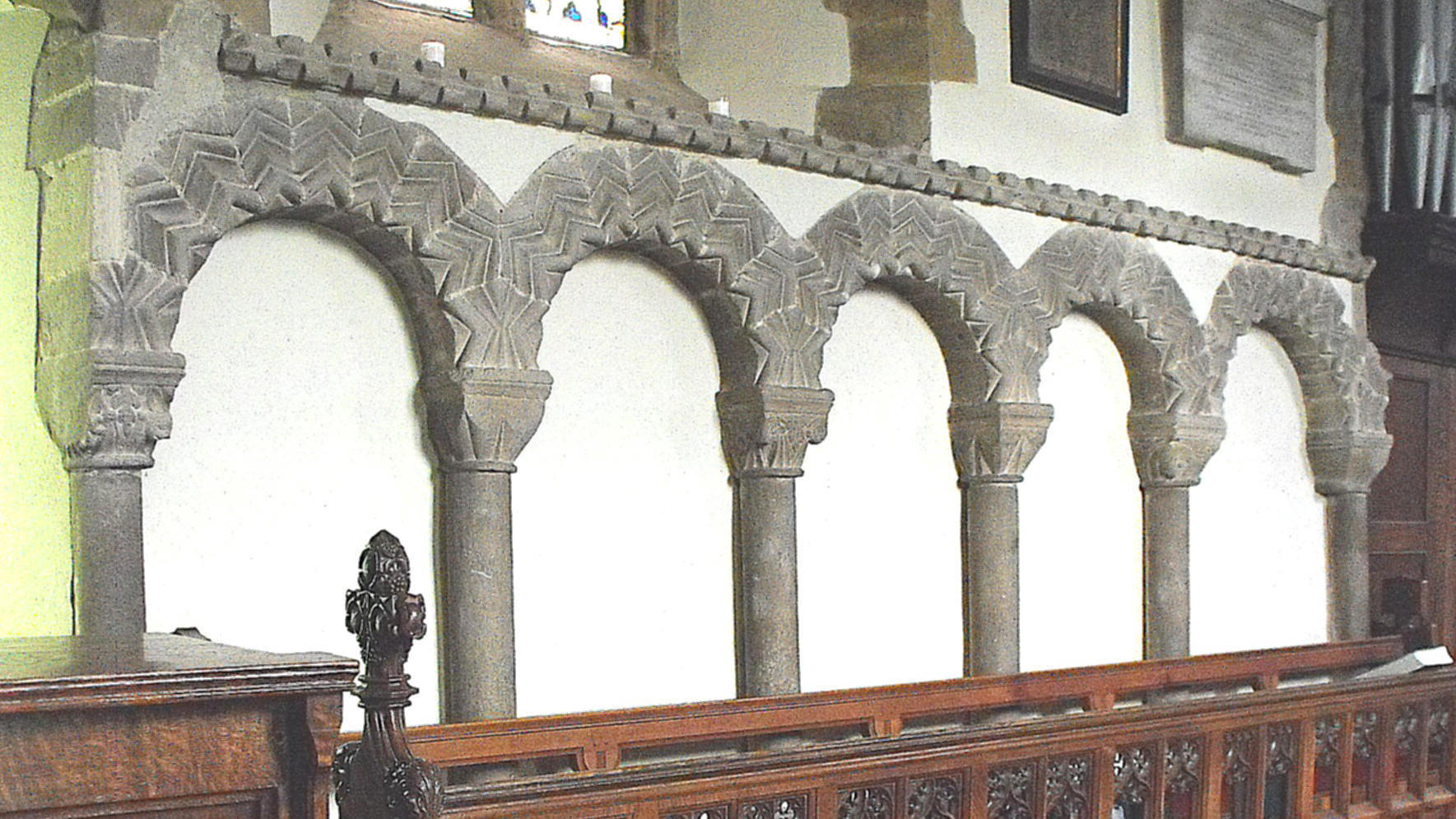
The Normans enlarged the church in the twelfth century by knocking down the original chancel and building a nave with a new chancel beyond. Little evidence of this nave remains but the chancel retains its interior blank arcading decorated with chevron, now consisting of five arches to the north and six to the south, supported on demi-shafts with a motley variety of capitals, including one with a grotesque (the second from the right, in the photograph above left). Three detached and very unequal arches to the south, now forming a sedilia, are a botched reconstruction of similar work that may once have decorated the E. wall before the chancel was extended a century later. Norman features elsewhere in the building include the re-set S. doorway (above right), now leading into the S. aisle but presumably once leading into the nave, formed of three orders decorated with chevron (first and third) and beakhead (second), supported on two orders of shafts decorated with cable moulding (first order) and chevron (second). The Saxon tower arch now communicating with the nave appears to have been remodelled at this time and again later: the Normans must have been responsible for its scalloped decoration beneath the abaci and its two rows of billet round the hood-mould, but the later thirteenth century appears to have given it its pointed form and its two inner flat-chamfered orders.
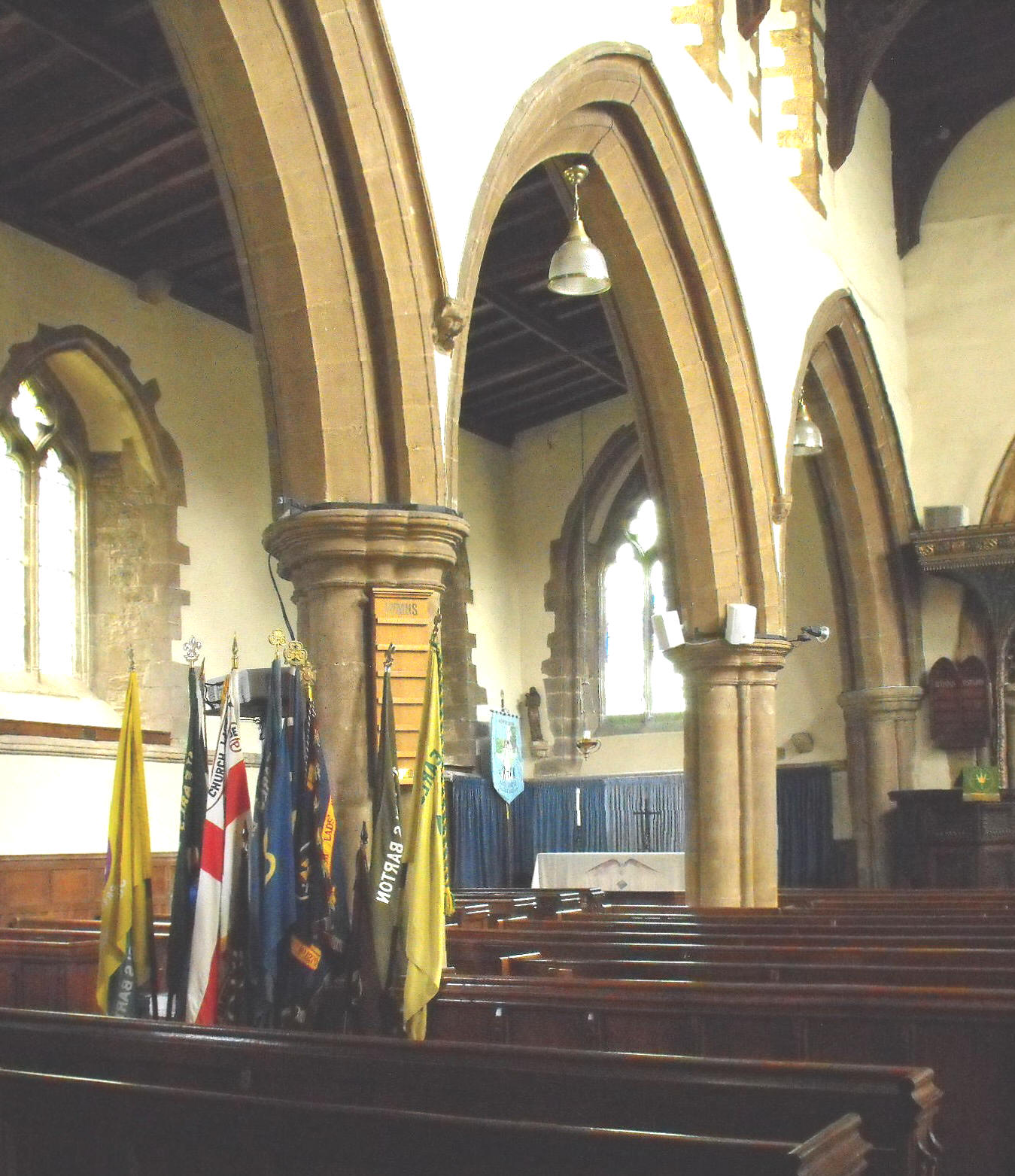
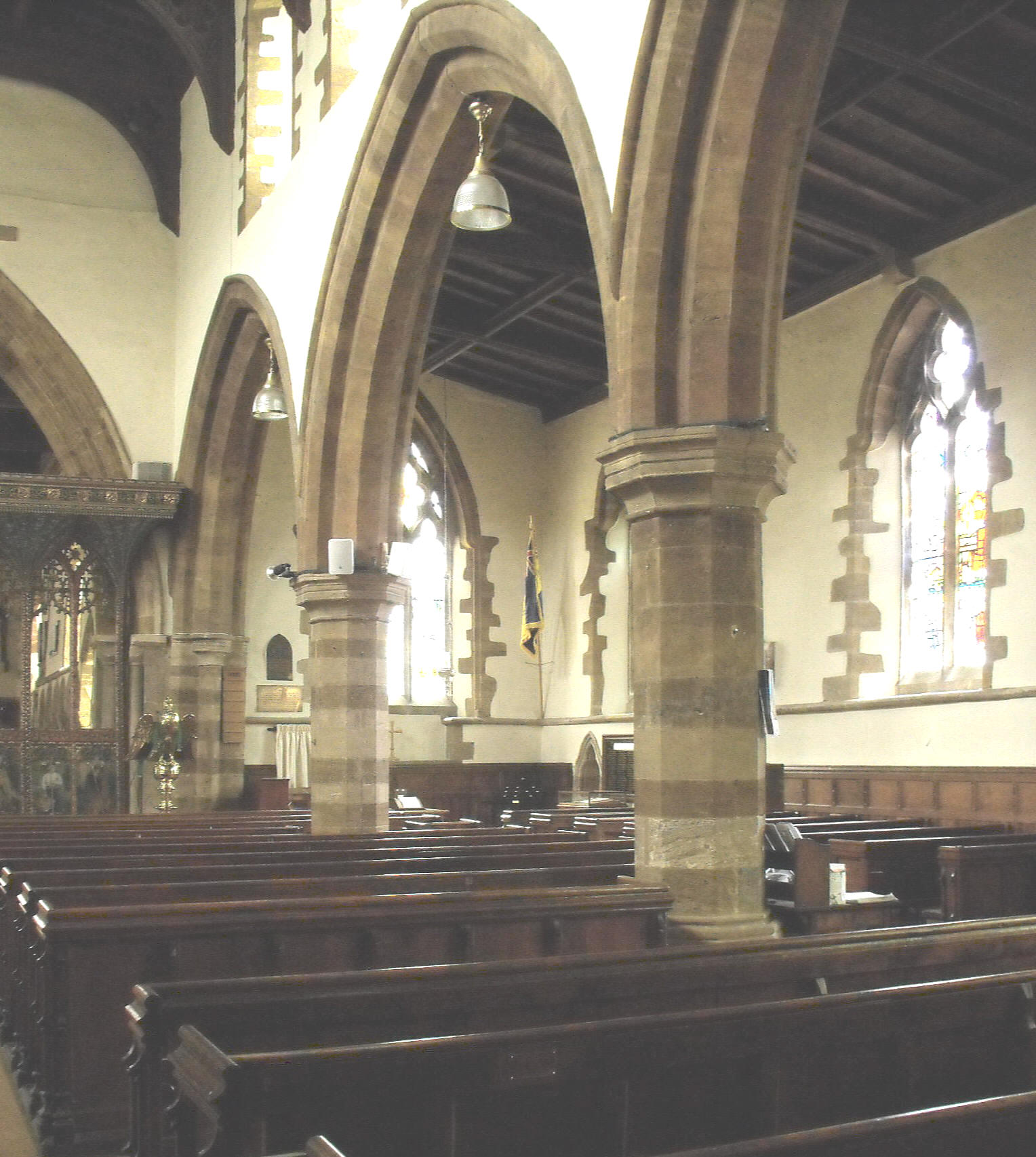
This second remodelling may also take us to the period of the S. arcade (above left), which Pevsner considered to be 'of the late thirteenth century' (The Buildings of England: Northamptonshire, Harmondsworth, Penguin, 1973, p. 196), although it is difficult to date with precision. Andrew Hart's c. 1230-50 seems a little early, however (Earls Barton All Saints' Church, p. 4), and his ascription of the N. arcade to 'some twenty years later', much too much so, as well as rather curious considering that he also describes it as 'Decorated' elsewhere (ibid., p. 16). Certainly Pevsner's 'early fourteenth century' is more consistent with closely dated work in other parts of the country - for example, at Isleham, Cambridgeshire, where similar piers dates from 1331 (but not the arches however). The S. arcade (above left) is composed of double-flat-chamfered arches supported on octagonal piers - an extremely common and almost undateable form, and it is the design of the capitals on which any attribution must rest here. The N. arcade (above right) is formed of arches of two orders carrying recessed flat chamfers, springing from compound piers formed of four major and four minor semicircular shafts, with capitals going all the way around. The chancel arch is composed of three orders to the west and two to the east, bearing flat or recessed flat chamfers above the original Norman jambs with cushion capitals.
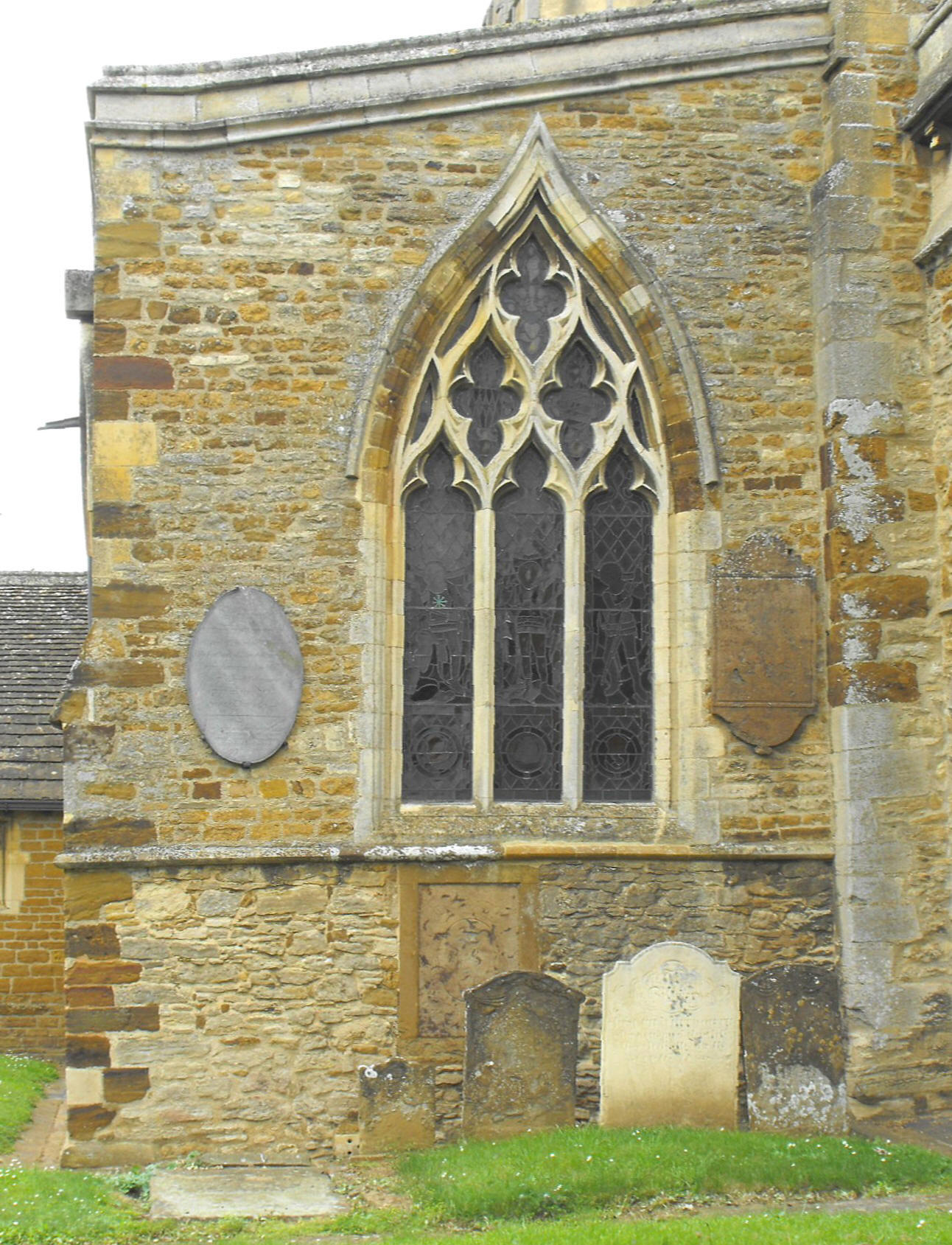
The aisle windows are also of two periods but here, the N. windows are probably contemporary with the N. arcade and it is the S. windows that may possibly be later. In both cases the windows are two- and three-light, with reticulated tracery characteristic of c.1320-50, albeit (again in both cases) of a rather pinched kind, but the main window arches to the south are ogee pointed, quite apart from the individual lights within, which is less common. (See the photograph of the three-light E. window to the S. aisle, above left.) Windows of other periods in the church include a two-light Perpendicular window in the S. wall of the chancel, the Perpendicular nave clerestory, a thirteenth century lancet in the N. wall of the sanctuary, and three stepped lancets in the chancel E. wall. The latter seem peculiarly squashed together, with only narrow shafts between.
Andrew Hart identifies the building stones used in the building as Barnack rag (from the Middle Jurassic, Lincolnshire Limestone) for the long-and-short work and lesenes of the tower, and ironstone from the Northampton ironstone (from the somewhat older but also Middle Jurassic, Northamptonshire Sand) for most of the rest (ibid., pp. 8 & 10). However, neither he nor Pevsner nor the British Listed Buildings web-site make any reference to the stripy limestone/sandstone facing around much of the building's N. side, which is clearly a High Victorian conceit, demonstrated - if proof were needed - by the fact that it continues around the projecting cross-gabled organ chamber of c.1870. This must have constituted a fairly major restoration, therefore, which leaves one wondering whether all the apparently mediaeval features of the nave, aisles and chancel are entirely reliable.
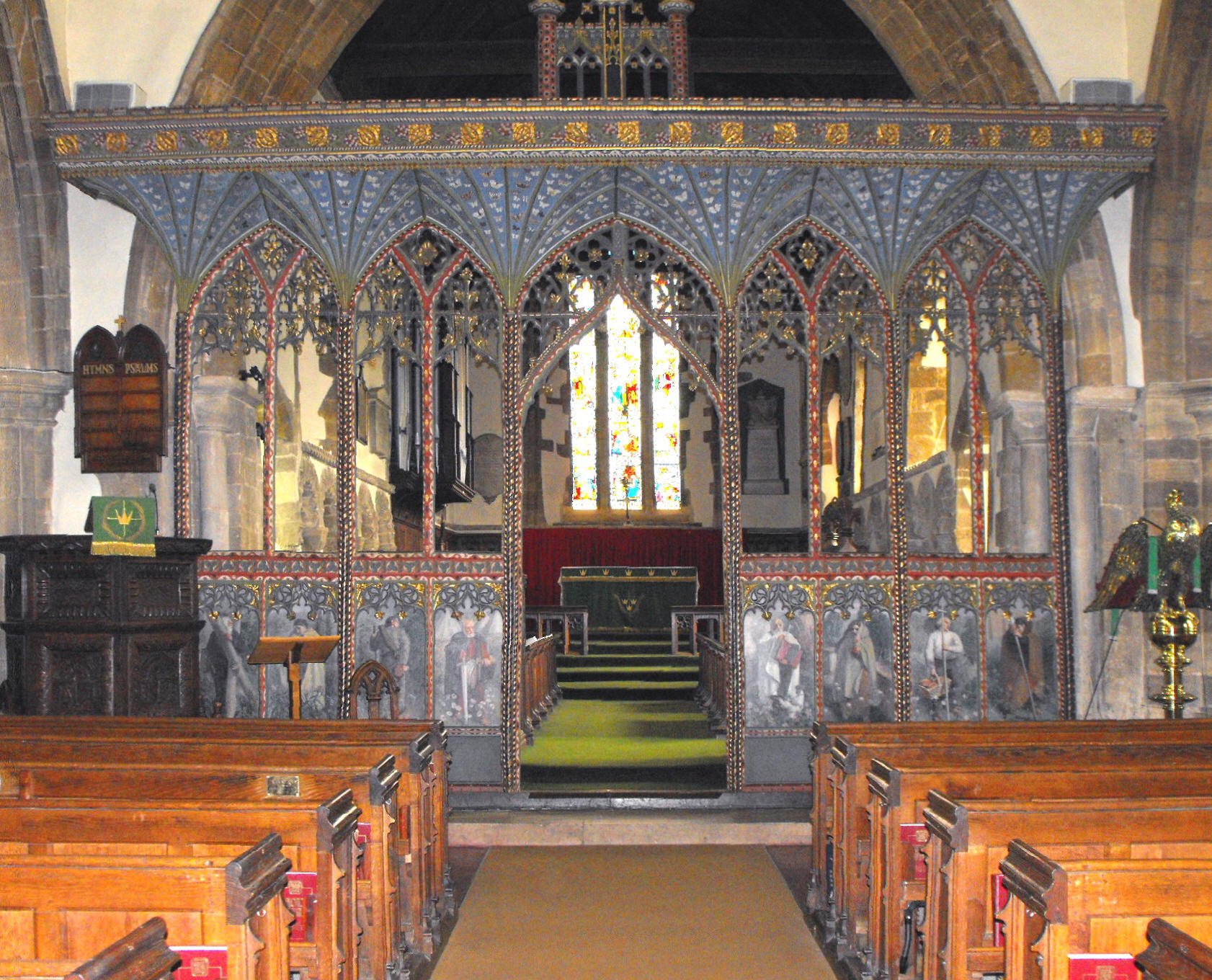
There is deception afoot for sure in the heavily restored rood screen (above right), for the attractive loft is wholly nineteenth century in date. Andrew Hart describes the pulpit as 'Jacobean' (ibid., p. 5), though the wider term 'Stuart' is probably a safer bet. It is not of great interest, but it is difficult to give any of the post-Conquest features at this church due attention, for inevitably and unavoidably, the tower overwhelms all.
|
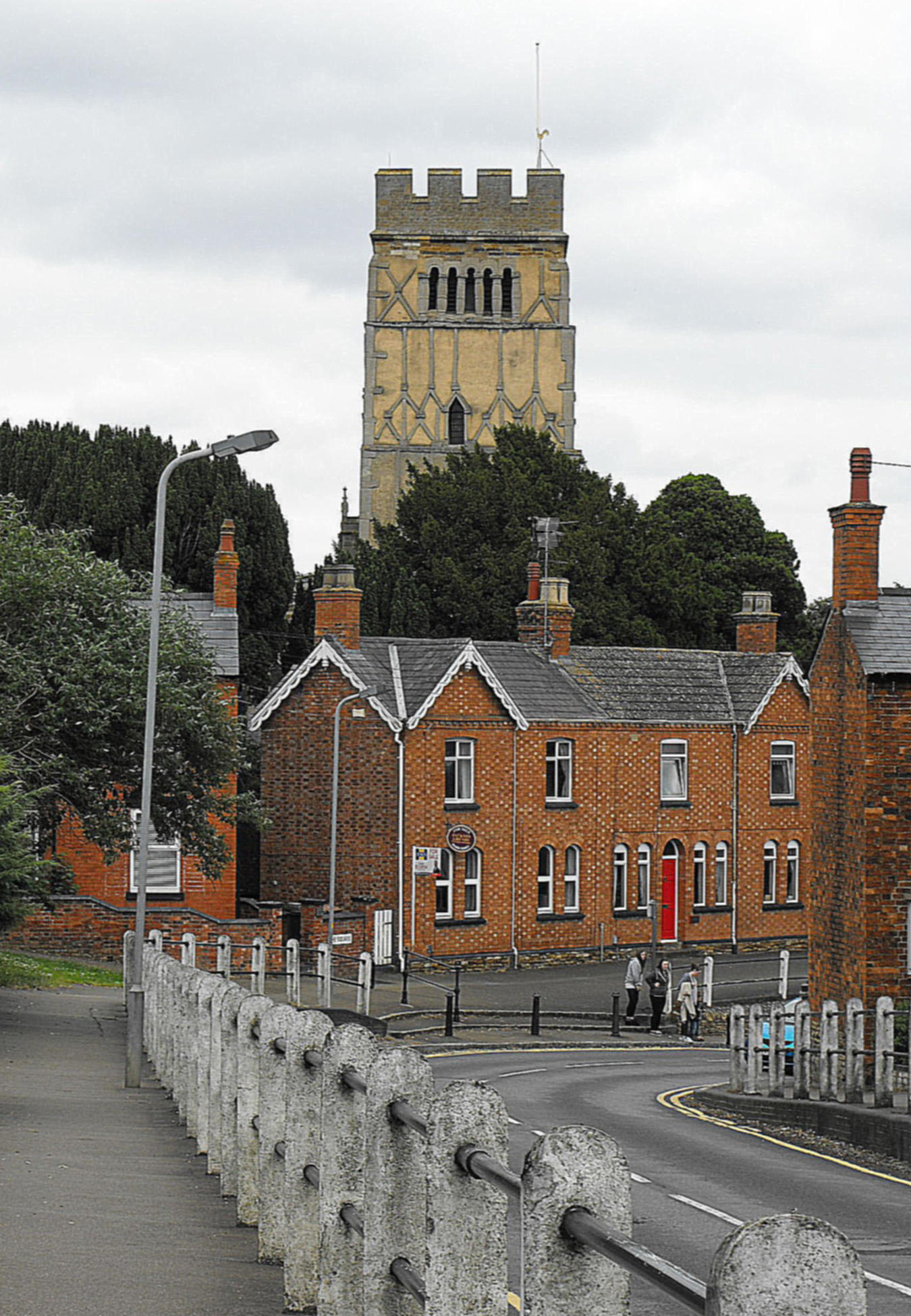 This
building is rightly famed for its spectacular, probably late tenth
century, Saxon tower, seen projecting high above houses as one approaches from the north (as illustrated, left).
Here may be found the best display in the country of the decorative use of lesenes or pilaster strips,
assumed
to be intended to imitate
half-timbered work, the usual form of construction at this time. In
stonework, they may have made a modest contribution to the bonding of the
rubble masonry but Andrew Hart in the church guide (Earls Barton
All Saints' Church, Earls Barton, All Saints' Church, 2006, p. 10) also makes
the interesting, very plausible and probably more important suggestion that the spaces between were
originally rendered, which would have given the tower a very striking
appearance. The tower provides a good illustration too of long-and-short work - a
Saxon method of laying quoins whereby the stones were laid alternately horizontally and vertically.
The tower thus decorated may originally have formed the main body of the
church, being joined only by a short chancel to the east. (Sir Alfred
Clapham, English Romanesque Architecture: Before the Conquest, Oxford,
Oxford University Press, 1930, p. 104.) It is unbuttressed and rises in
four stages, each slightly recessed from the one below, to later mediaeval battlements.
The Saxon roof may have been pyramidal. Doorways in the upper stages
(one each to the south and west) were probably accessed by ladder, implying
they were not in regular use. Stonework comprising patterns in inverted
'U's and 'V's has the same thickness as the lesenes, and the baluster mullions
between the bell-openings have the
characteristic (for the period) central bulge.
This
building is rightly famed for its spectacular, probably late tenth
century, Saxon tower, seen projecting high above houses as one approaches from the north (as illustrated, left).
Here may be found the best display in the country of the decorative use of lesenes or pilaster strips,
assumed
to be intended to imitate
half-timbered work, the usual form of construction at this time. In
stonework, they may have made a modest contribution to the bonding of the
rubble masonry but Andrew Hart in the church guide (Earls Barton
All Saints' Church, Earls Barton, All Saints' Church, 2006, p. 10) also makes
the interesting, very plausible and probably more important suggestion that the spaces between were
originally rendered, which would have given the tower a very striking
appearance. The tower provides a good illustration too of long-and-short work - a
Saxon method of laying quoins whereby the stones were laid alternately horizontally and vertically.
The tower thus decorated may originally have formed the main body of the
church, being joined only by a short chancel to the east. (Sir Alfred
Clapham, English Romanesque Architecture: Before the Conquest, Oxford,
Oxford University Press, 1930, p. 104.) It is unbuttressed and rises in
four stages, each slightly recessed from the one below, to later mediaeval battlements.
The Saxon roof may have been pyramidal. Doorways in the upper stages
(one each to the south and west) were probably accessed by ladder, implying
they were not in regular use. Stonework comprising patterns in inverted
'U's and 'V's has the same thickness as the lesenes, and the baluster mullions
between the bell-openings have the
characteristic (for the period) central bulge.